Naomi Alderman spent a fantastic hour on the You and Yours programme yesterday, talking about her new idea (and trial of) a “Couch to 5k esque” plan to help get back in to reading, in the age of distraction.
First of all, this program, as I’m conceiving it today, is essentially intended for people who have great memories of reading enjoyably but have found that their brains have been sucked into social media and the smartphones. It feels like a long time since they were in a regular enjoyable life-sustaining reading habit. It’s not our fault. When we bought our first smartphone, we didn’t know that they were going to have this addictive or compulsive effect on us.
I came across an article from the Library of Congress where they asked attendees at a conference what their earliest memory of the internet is. I love this!
I can’t be entirely sure it’s the earliest, but very, very early on I remember a friend helping me create a Hotmail account, and being utterly terrified for a few months that a huge bill was coming for my Mum. I had no concept of a free service. The bill ended up being a shitty service, instead of monetary!
I’m really interested to hear - what’s your earliest memory?
Week one of focusing on not being sucked-in to the internet as much has gone well. I’ve thought about writers and video authors that I respect, and either do - or want to - read everything they write. A short list that it takes a lot to get an entry on to.
I have then added these, and only these, to Reeder which gives me a single, gorgeous space to keep up to date with the ideas and topics that matter to me.
To accompany this, next week - using a different RSS feed reader - I am going to add feeds that keep me up to date. These feeds will only consist of release announcements of important (to me) software, at least to start with. I’m aiming for no “general news” or commentary. It’s useful information.
That keeps two important things separate - things I want to read, and things I need to know. I can attend to them at different times.
The current list in Reeder:
JA Westenburg (almost every post feels relevant to me, and gets me thinking usefully)
Andrew Lock (deep dives in to new .NET features and capabilities)
The Marginalian (incredible notes on books and philosophy - utterly unique)
I’ve taken a smug pride in not being algorithmically captured, my senses rendered useless scrolling TikTok, or Facebook. Scroll with no headphones on in a public place and I will be instantly enraged. But I think it’s time to finally admit the slight, or indeed large, projection going on here.
I might not flick through influencers, but I refresh Hacker News and email habitually (in the literal sense). Rarely does an hour go by without me “quickly checking BBC News”. My spare, or at least unplanned, time is filled with a version of a screen. Whole evenings disappear with the next episode of something, but that’s okay because it isn’t Netflix. If it was Netflix, I’d be like everybody else, wasting their time...
I’m realising how overstimulated I am because of this, but I’m starting to spot the traps that got me here.
When I was an early teenager, I escaped the world through the internet. I was mesmerised by the expansiveness of it all. The people I can talk to on IRC, the little tools people were building, the latest little widget for your personal site. It felt unlimited in a way that is not the norm these days. There was momentum and positivity. It was fun!
Now, a pseudo-expansiveness feels a million ways to get the next quick hit. Cmd+T gets me to the next thing I can convince myself I need to know. It isn’t driven by a passionate interest, more of an anxious need.
The commercialisation of that precious (at least, to me) space has a part to play in subduing the excitement. The projects that bubble up to the surface always have a money-making angle. Finding something shared for the fun of it is almost a forgotten memory. If it isn’t a side-hustle, does it exist? Open source has to have a Pro plan alongside it.
Last week, I hit a crisis point. I couldn’t refresh any faster, I was seeking dopamine like a scarce resource. The room was on the verge of spinning, if I’m honest. The heat wasn’t helping.
I decided a detox of a kind was needed. This can’t go on. The need to feel connected, updated and entertained needs attention - it’s making me unhappy, in truth.
It might turn out to be simple, but right at this moment it feels like something that needs to be strategised out of. The easy answer is to close the laptop, put the phone in a cupboard, and walk outside. Heatwave aside, I’d be missing out on something that honestly is my passion. That doesn’t feel ideal.
I don’t have all the answers, but I have a few ground rules to get me started on this and I aim to keep a good awareness of their impact.
I’ve uninstalled a lot things from my phone, and my home screen is simply messaging apps. I am horrendous at replying to messages, so a nice side-effect may be that I get back to people a little better. The general gist is my phone is for communication (shock, horror).
I am looking for communities and areas of technology that excite me for the right reasons. Things that energise me like they did in the late nineties and the few years after. I’m talking about lobste.rs, instead of Hacker News. The Fediverse. Tilde pubnix communities. Any forge that isn’t GitHub. I’m finding the people who are passionate and not looking to commercialise the world. Change your inputs... etc.
LLMs have made me, and a lot of us, feel that writing a blog or publishing our scripts/software is now tainted in some way. Either it will be gobbled up by their agents, or people will assume you’ve written it using them. The theory of LLMs killing the open-web is now reaching forgone-conclusion territory. I have decided to ignore all that and participate anyway. I trust that enough people around the world want the same kind of web as I do as to build places that are worth visiting and being a part of.
With ADHD, out of sight is often out of mind. So making my shell account on a pubnix my “home”, with it’s RSS reader and IRC client, means I don’t see the Youtube feed. I don’t have a browser tab to refresh the news within.
I won’t make promises I can’t keep, but I feel like I want to blog about this as I go. I don’t feel like I’m the only one that has convinced themselves they are different to the TikTok scrollers. I think a lot of us could do with help as we feel the web we thought we loved crumble. Help that isn’t panic-ridden, and depressing, but is more “come over here, let’s do the cool things together and leave them all to it”.
To make sure it still works when someone changes something in the future
Okay, there’s definitely more benefits to testing than this - but these, for me, are fundamental.
Mutation testing helps with the second one. If changes are made to the codebase, tests should fail. If they don’t, you likely have missing tests.
I use Stryker as my tool of choice here, because I’m in .NET land. Stryker takes your production code, and starts making thousands of little tweaks one at a time - inverting booleans or comparisons, emptying collections in initialisers - loads of things. The full list of “mutations” is here.
And then, it tells you which changes didn’t cause test failures, so you know where your testing gaps might be. Handy!
Say you have the following method in your production code:
public static string GetGrade(int score)
{
    if (score >= 90) return "A";
    if (score >= 80) return "B";
    if (score >= 70) return "C";
    if (score >= 60) return "D";
    return "F";
}
Okay, not the best approach to this in my opinion, but let’s go with it. Stryker would change those >= comparisons one at a time to, say, >. If you don’t have tests that cover the boundaries here (like a score of 90, asserting a return value of A) this will highlight your mistake.
As more and more code is produced by LLMs, I believe tests that prevent regressions become more important. We all know they sometimes churn out rubbish, or make assumptions. Maybe the diff that came back was huge, and you didn’t quite pay it the attention it deserved. Having detailed tests are going to pay off in these situations. They also give the LLM tighter guardrails while it’s implementing things - broken tests help nudge them in the right direction (as long as they don’t just rewrite the test...).
At least on mine, the homepage of the discovery tabs now shows video feeds in a very prominent position.
Now, I personally see this as being late to the party. Yes, video podcast RSS feeds have always been available to use within Apple Podcasts (I have a few, mostly from TWiT). But I’m old enough to remember Miro / Democracy Player and Odeo - where I first realised how much I could like a clean feed of video shows.
(I sometimes feel like I’m the only person weird enough to remember things like this - let me know if you are weird too!)
Apple’s push is welcome for me, as long as it doesn’t come as part of a strategy to put walls around the podcasting garden. Anything that stops me opening up YouTube for video is appreciated (I’ll just get lost for hours).
Nice overview of the new Thundermail service from Kev Quirk:
If I’m honest, my first impressions are underwhelming. I get that this is an early preview but for the price, services like Zoho and Fastmail are better services, and better value for money.
I don’t regret signing up though - it’s important to support open source services, and as Thunderbird Pro matures, it will hopefully evolve into a service that can contend with the OG’s in this space.
A nice overview of FediForum and 2mr.social - two recent fediverse conferences:
Across both events, the open social web is widening out a bit. FediForum gave the headline slot to a Dutch MEP and put introductory talks on both ActivityPub and atproto on the program. 2mr.social brought politicians, media and civil society together in Hamburg, and ended with a declaration framing Matrix, the fediverse, and atproto as three parts of one European social stack.
I read Anil Dash’s post linked by Tim Chambers today, and find it hard to see past the inevitable outcome. When we can’t tell between a human or an LLM system participating in the open web, there are no plausible guards against the decimation of openness.
My initial thoughts have been towards the idea of a closed system which has openness inside. Rival closed systems that regulate their inside. Taken to an extreme, this would be specific hardware and operating systems designed to only permit vetted software to run that was known not to include LLMs. Putting aside the feasibility of such a system, it would be the ethical opposite of the foundational principle of open-computing: to participate by writing your own software.
If sharing your ideas, thoughts, knowledge on the web means feeding a beast that is rapidly controlling your own access to information, that’s a deal a decent proportion of thinking people would not feel comfortable making. Where are these things to be shared instead?
Yes, in-person. Yes, books and printed media. As much as I value those things, the international and immediate nature of the open web is then lost. We regress in levels of global connection.
I don’t have any answers - but I truly hope some emerge, and quickly.
So what becomes valuable, in a world like this? Not more content. We are drowning in content. What becomes valuable is someone you trust, saying: This is worth your time. Here’s why.
That’s curation. And it’s not new.
A superb entry from Matthias on blog curation (packed with great links)
I have always assumed degrees of attachment to physical places and environments differ from person to person. Being neurodivergent, the signals of safety (or otherwise) and familiarity (or otherwise) from the space around me can play a large part in how I’m feeling, thinking and functioning. I’ve watched various people leave homes, offices, third-spaces and never think of them again. In a way, I’m envious.
Places are anchors.
I’m home, no one can introduce things I don’t expect. The local supermarket (a common autistic regulation place, I’m led to believe) - I know where things are. I know where the things I like are.
I know how it feels to be in a certain office, a certain staff room of a school, a relative’s home.
When these places change, or become somewhere I can no longer go - there is grief. Something that helped shape my world has become something else and I have lost it.
I’m moving home tomorrow for the first time in over 11 years. Although at times desperate to move, I’ve avoided it for at least half of those years. Even with its faults, it’s a sanctuary that cannot be replicated anywhere else. However comforting my next main place is, it can’t comfort in the same way, because it isn’t the same.
For a short while I will be anchor-less. Unmoored, I’ll likely take refuge in other places that I am used to. Supermarkets, coffee shops - the people, shelves, tastes, smells and sounds that soothe only because it isn’t the first time I’m there.
Logically, I know my new home will provide as a sanctuary soon enough. It will change me in slight ways because of how it is. How the light moves through it on a normal day. What noises are common to hear. The people in the other houses on the street that I sense, or talk to. They will all start to have an effect on where my attention goes.
Nick Cave talks about us as creatures of loss. Acceptance of that is a loss in and of itself. Losing people, places, thoughts - it happens all the time. I think I’m finally ready to lose this shell for a new one.
All I know for sure is that using Surf leaves me feeling better about the state of the internet. I am aware that the net is rapidly filling up with AI-generated slop, and that, furthermore, the technology’s impact on search and advertising threatens to disincentivize humans from bothering with the medium at all. But for now, there’s still lots of great stuff out there—and Surf is a refreshingly inventive way to find it.
I’ve been playing with Surf this week. I had the iOS beta months ago, but some kind of bug made me lose interest. Now, however, I’m having great fun making feeds and calmly reading through others. Love it.
The official White House Android app has a cookie/paywall bypass injector, tracks your GPS every 4.5 minutes, and loads JavaScript from some guy’s GitHub Pages.
I had other plans today, but illness confined me to the duvet and I decided to attend the Green Party Spring Conference I had tickets for. I’ve spent a couple of weeks absorbing the agenda, looking forward to hearing debate around issues that affect people’s lives and helping to shape our policy platform.
Unfortunately, that was not to be. The day started with the voting system crashing continuously. There has been suggestions that this was a DDoS attack from interested parties, but I’m personally yet to see evidence of that.
What came next was hours of in-fighting that to my mind is reserved for the Labour Party or a SWP free-for-all. It was not until 3.20pm (after starting at 10am) that the first motion - the Standing Order Committee Report - even came to a proper vote.
Now, I should start by saying I am new to this. I don’t know people’s history, associations or viewpoints. But what I saw was SOC members accusing each other of power grabs and taking votes away from a sovereign conference. One SOC member, Martin Hemingway, misgendered another in a particularly nasty moment. I can only assume they know each other as long-standing members of the same committee and thus this was intentional and spiteful.
Votes of no confidence were continuously raised against the Chair, which - to a neutral party - were doing all they could under trying circumstances. By the third, I almost voted no confidence just to give them a break.
Once the SOC Report was finally voted through, things started to move on. There were short discussions on each topic and voting worked. However, a growing grey cloud of time running out was creeping overhead.
Time neared 5.30pm - 15 mins until the end of the conference. From my agenda sheet, not very much of it had been covered. I realised that what seemed to be the most contentious motion - that Zionism is racism - was about to come up. An extension of 15 minutes to the day was requested, voted on and agreed.
Cue more spurious raising of votes of no confidence against the Chair in a transparent, anti-democratic act of wasting time from people who quite obviously did not want the motion to be up for debate or vote.
In response, someone raised a motion to basket the amendments (group them and vote on them in one go) to the motion in a desperate attempt to have the Zionism motion heard in time. We heard an impassioned, tear-filled plea to vote for the basketing from someone whose family have suffered greatly at the hands of the Israeli state.
Just as they finished speaking, time had run out. The Chair, exhausted and emotionally drained, said their goodbyes as fast as they could and the Zoom call ended. A blank screen stared back at me and I wondered what the hell I’d just seen.
I came to this conference with excitement, but it seems several groups of opposing views on many subjects were unable to resist trying to stamp each other out. This isn’t the Green Party I have seen elsewhere. North Herts Green Party are a beautiful group of people with differing views but are respectful, kind, and pulling together. This Zoom call bun fight was embarrassing to be a part of and we must do better.
I don’t have the insight to know what needs to change, but that was a farce. People had dedicated weeks - months - to researching and preparing motions. Attendees and organisers gave up their Saturdays and money to contribute to the future of their party and some people chose to ruin that by trying to silence the other side of whichever debate they are overly married to that is stopping them being adult, reasonable members of a political party.
Maybe this is a fruitless call in modern politics, but if there’s a chance to ensure respectful debate and democratic voting on policy it must be taken. There are important things at stake.
One of my favourite parts of the blogging community is replies. Not comments, but replies on one blog to a post on another. Well thought out responses to well thought out points.
The conversation evolves with patience and async joy - a stark contrast to the fast, short retorts of social media.
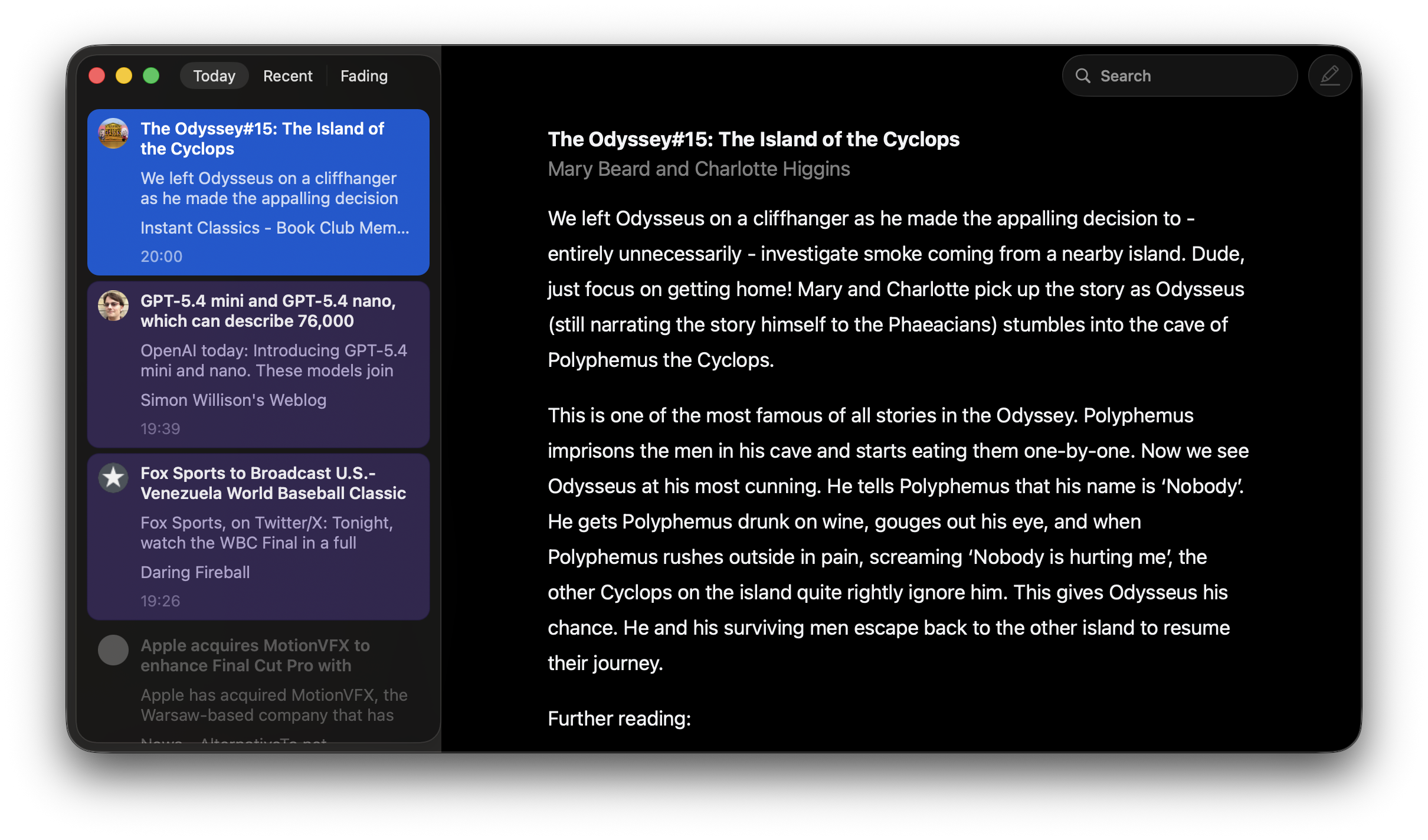
Manton Reece of Micro.blog (where I host this blog) has recently added Inkwell to the service’s line-up of useful tools. It’s a pretty RSS reader which has thoughtful integrations with Micro.blog proper.
For example, I can highlight parts of a post, and compose a reply post right from there. I can save this as a draft to add to later when I have more thoughts.
There’s a nifty feature called “Fading” which can summarise posts over a week old, reducing any fear that you might miss something interesting in your feeds.
I appreciate the intention of Inkwell - reading your feeds is not another task. It should be a cosy home base to catch up with other thinkers and tinkerers, and contribute to the conversation in a real way.
Though NetNewsWire is an amazing piece of software that has served me well, Inkwell might just prompt me to write more.
The Silver Book is a beautiful novel that I couldn’t, won’t let go of. Queer love intertwined with 1970s Italian filmmaking, and the march of fascism in the background.
The writing is exquisite, I ate up every word. The emotion was not just put on a stage for us to see, it’s wrapped around us, forcing us to feel as deeply and openly as Nicholas and Danilo did.
The spectre of impending grief is on every page, but so is the teasing of ecstasy. Life is cruel, uncertain, and exhilarating in equal measure.
One of the strongest themes of the book for me was the false hope in running away. Burying experiences, our feelings, is more of a snooze button than an off switch. They lay beneath our conscious day, and we beat them down quickly when they show signs of waking up. But it is inevitable that they will one day exhaust you in to giving in to their confrontation.
Nicholas has run away to a situation he knows, Danilo knows, is unlikely to hold forever. Nicholas’ time in Italy always feels temporal, like an extended holiday. Neither of them even pretend that “it’s different for us”. The longing is eternal, circumstances are not.
The entire cast’s celebration of queerness even evokes a temporary reprieve from captivity. Fascism looms. Might the party end? Camp and its excess of joy begins to feel the boot on its throat.